Saturday, March 5, 2011

Markets and Monasteries

It was rush hour on the banks of the Yangon River. Small motorized boats ferried the population across the river to work or school, some picking up breakfast on the way from an array of open air vendors, others carrying a hot Tiffin tin in hand.

Labourers offloaded 100 pound sacks of rice from the river boats. The process involved each worker picking up the rice sack and a coloured stick, both of which were deposited at the top of the ramp.

The collected sticks acted as an abacus signifying the number of bags carried and payment owed.

Walking from the river San took us to the street market. Chillies, onions, garlic, ginger, tamarind, ground spices and beans were attractively laid out in amongst makeshift kitchens serving breakfast while monks collected alms.

From here we crossed the street to the fresh market. Market goers were in good spirits and the interaction was entertaining to watch.

One lady had a troublesome child and through San wanted to know whether we would like to take him back to Canada with us.

Young boys worked an elastic dough intended for thin pancakes used in spring rolls, dumplings and soups. Other boys worked the griddles and efficiently cooked, stacked and wrapped the pancakes for sale.

Many women and children had their faces daubed with thanat khar. This ground tree bark paste provides sun protection and is also an effective cream, making the skin smooth and warding off acne.

We walked a street adjacent to a hospital where families are responsible for feeding family members who are patients – the market is ideally located for this purpose. We continued to a colourful flower, fruit and vegetable market – it was strawberry season and they looked luscious.

At the centre of town Yangon’s traffic converges at Sule Paya, a 2000 year old golden temple flanked by a convergence of decaying colonial edifices mixed with newer construction. It was quite the scene – the Stupa itself was being renovated and the golden dome was neatly covered in pieces of rattan woven together, in itself, quite attractive.

Traffic and people vied for their place on the road and on one corner a "Wall Street Shuffle" of sorts was underway. It’s a cash world in Myanmar, banks are not completely trusted by the locals and an underground economy prevails. Money changers walk openly carrying wads of kyat – you need lots of it – on the black market a dollar will buy around 1100 kyat.

Beyond the money changers, used book stalls lined the street and in amongst them telephone stalls. The telephone minder manages the phone line from an old rotary phone, customers paying the required fee - few people own a phone.

The Strand Hotel with its 32 luxury rooms is a bastion of a bygone colonial age and a welcome temporary refuge from the heat before we continued on to Scott Market, or Bogyoke Aung San Market as it is known locally. Lots of bargains to be had and plenty to eat – Myanmarians love their food.

We ended the day at a monastery that houses novice nuns and monks, some as young as six years old.

Many of the children have been orphaned and the Monks have taken over their welfare. I couldn't help feeling sad for all those little ones without a mum or dad.


Friday, March 4, 2011

Rangoon Evokes A More Exotic Image

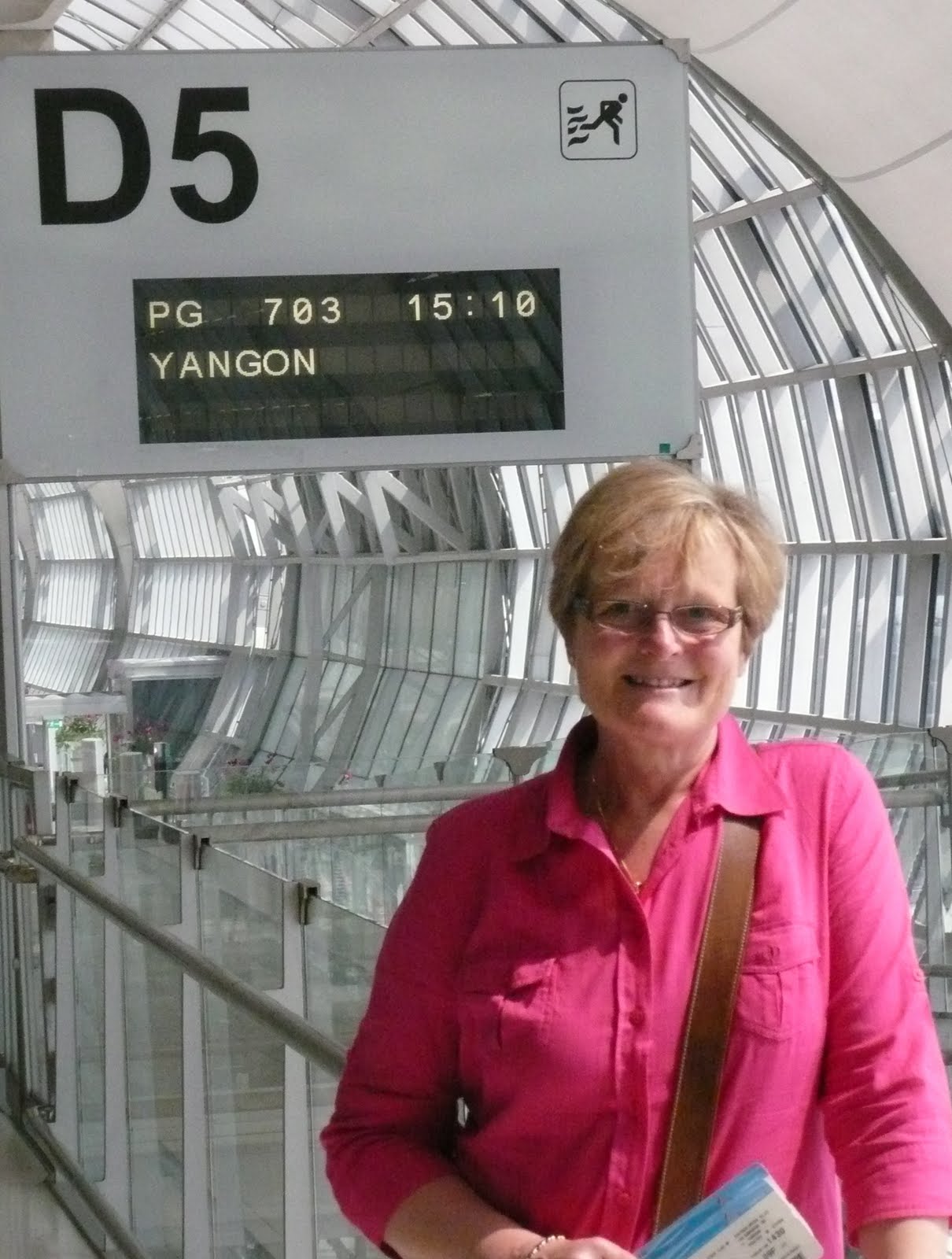
Its rare these days to take a plane with empty seats but the Bangkok Airways flight to Yangon - the Rangoon of Colonial times - had 26 passengers and 130 empty seats. The one hour flight from Bangkok went quickly with a hot meal served and just enough time to complete the Myanmar entry paperwork.

Immigration formalities at Yangon Airport were brisk and efficiently handled, passports and visas meticulously checked. Beyond the well-staffed, uniformed officials we could see our guide San waiting patiently with a big smile on her face.

The line up for diplomatic passport holders was noticeably long and during our stay in Yangon we were struck by an impressive embassy row, many countries with sprawling, well-kept premises. With Myanmar’s capital moved to a greenfield site 300 kilometers north of Yangon about five years ago, we wondered how all those diplomats would feel leaving their colonial style residences for the new, modern capital of Nay Pyi Taw. Word has it that once the new international airport has been completed, the diplomatic community will move north.

We drove into town in a right hand drive vehicle, driving on the right hand side of the road. There is a mixture of right and left hand drive vehicles – catch up is taking its time since the change in driving rules after the end of British colonial rule. School was turning out for the day and buses filled with children in green and white uniforms, empty Tiffin tins in hand, made their way home. The Tiffin tin with its various compartments layering rice, vegetables and curries was a common sight throughout our stay in Myanmar.


The sprawling Traders Hotel in the centre of town is a bit of a monolith reminiscent of old-style communist era architecture, even though the hotel is more recent than that. What it lacked in attractiveness was more than made up by friendly, helpful staff.

Even down to the front desk clerk who respectfully told us that if we lost the safety deposit box key it would cost us $400 and take 4 hours to break the lock – so – if we had a flight to catch we would need to consider that. And then there was the hotel bar and its mysterious display of Johnny Walker Black Label, each bottle claimed by its owner with a yellow post it note.

The breakfast buffet was a hybrid extravaganza with many options, arranged in no particular order. Croissant next to steamed prawns, cheeses next to pork dumplings and the omelet station next to the fruit tray. But I do recommend chapattis and baked beans, I discovered they’re quite good together.

Seated by a window in the cavernous dining room we opened the net curtains to watch activity on the street - passers by looked in on us, most smiled and some waved.


To quote Rudyard Kipling "This is Burma, and it will be quite unlike any land you know about".

There was no doubt about that.


Thursday, March 3, 2011

On The Waterfont - Honestly!

This morning we motored over to the fishing village where we pulled up again at the cheroot maker’s house. We were going to see life on the water through a villager’s eyes.

The previous day we had received an informal demonstration in the village on cheroot-making from three ladies who worked with great skill and at breakneck speed.

Once the cheroots are inspected they are grouped into 50s or 100s but no one counts – fingers are stretched around a large handful of the finished product and when it feels right, there is confidence that the appropriate number has been reached. Joe demonstrated the technique. The bundle, destined for sale in the market, is quickly tied with raffia and set aside.

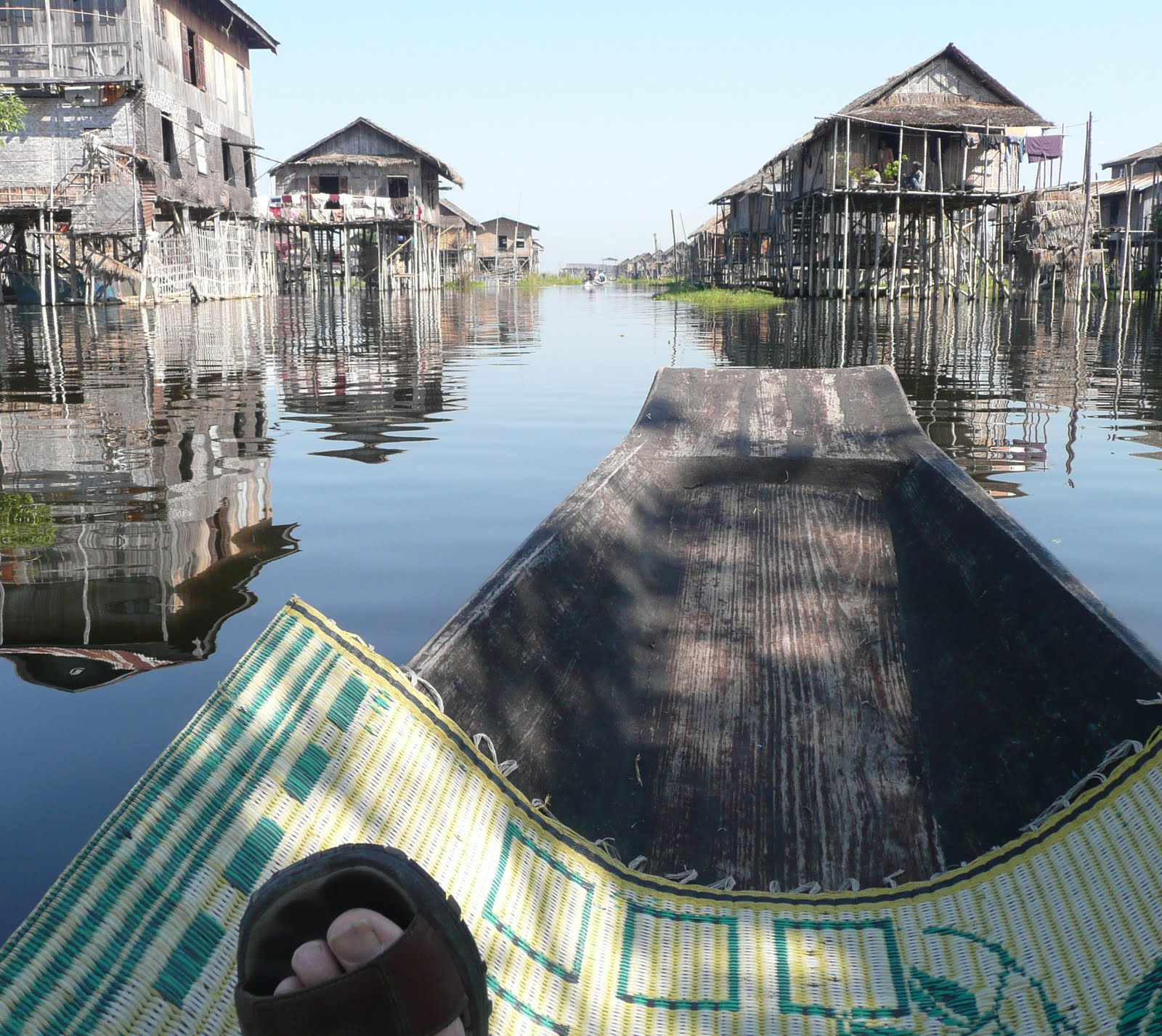
Back on the dock the ladies removed the rattan mats they had been sitting on to make cheroots, placing them on the base of the canoe that would take us around the village so that they covered a couple of minor leaks.

Stepping into the flat-bottomed narrow wooden canoe proved to be an exercise in concentration and balance. We both sat down rather awkwardly on the mats and as I adjusted myself in the swaying boat, I found myself gripping its sides only to find that my fingers were knuckle deep in water.

Clearly we were quite literally going to be “on the water” and hopefully not "in the water".

For the next hour the cheroot maker’s young son paddled us along the watery streets where morning commerce was underway. Similar boats passed us laden with produce or vegetation from the lake bottom destined for the floating gardens. Women washed their clothes - and their children - from a canoe or from the wooden steps of their homes.

Grandmothers hung out washing to dry, threading garments on to bamboo poles, ducks cackled loudly, a pig in its elevated bamboo sty snorted and cats stalked through the collection of stilt supports and moored canoes in businesslike fashion.

Not many men around – they were hard at work out in the lake bringing in the day’s catch.

Back at the cheroot maker’s house a couple of people were looking out of their windows to watch the spectacle of us trying to get out of the canoe on to the dock.

It wasn’t a pretty sight but it was probably the best entertainment they had had in a while.

We were as graceful as we could manage, given the situation.

Wednesday, March 2, 2011

Weaving Through The Five-Day Market

A morning market takes place for Inle Lake residents but its location rotates between five different communities enabling the people of the Hill tribes to travel between the locations with their goods.

Our arrival proved to be yet another experience where we felt as though we had dropped in from outer space.

Stepping over a series of moored boats to get to the shore, we walked up an uneven path to a crude bamboo bridge, with one token handrail attached rustically to uncertain looking uprights with nylon rope.

Once over the bridge we took in the scene. Life bustled with traders, and when we had passed the obligatory tourist stalls, the peoples of the Hill tribes who had trekked for hours to be part of the action, were distinctive in their black clothing with colourful headdresses.

Under a series of corrugated tin roofs and colourful tarps, coconut matting formed the floor. The challenge was to take in the enjoyment of the scene while avoiding serious injury from a jagged tin gable or a garrotting from a tightly strung nylon rope.

The assortment of items on sale was colourful – tomatoes, eggplant, scallions, peppers, betel, beans and garlic. Eggs were laid out on mats, their stalls tucked in amongst displays of every conceivable kind of vegetable, fruit and grain.


A brisk trade was taking place in cheroots, there were people making pancakes and other snacks, and old sages discussed the merits of their fighting cocks.

Dogs watched the pork seller in anticipation and all the while there was a constant chatter – the market simply bubbled with energy.

The Inle lake area is also well known for its weaving industry and I was particularly interested in this stop after the morning market. Shan-style tote bags used by many Burmese are produced here. High quality hand-woven silk and a unique fabric produced from the fibre of the locally grown Egyptian lotus plant are woven on bamboo looms. Doug was extremely patient while I satisfied my need for a spot of retail therapy - easily accomplished from the large array of finished items on display.

Another wonderful day and as with every experience we had in Myanmar, the people proved to be curious, gentle and charming.

Jumping Cat Monastery

Burmese cats have existed in southeast Asia for more than a thousand years. Originally they were kept by the nobility as well as being used as temple cats.

While pure-bred Burmese cats have long disappeared from Myanmar, on our days cruising Inle Lake their descendants were well entrenched, often spotted enjoying the sunshine lying on window sills, on docks or even stretched out in wooden canoes.

At the Inle Princess Resort we made the acquaintance of Chumo, who rather resembled the real thing. At dinner the first evening he marched, some might say rather brazenly, into the hotel dining room from the deck. He gave me a non-committal look - as cats do - jumped on my lap and promptly went to sleep. The fact that we were well into our meal was of no concern to him.

But that's cats for you.

One of our stops earlier in the day had been to Nga Hpe Kyaung Monastery – a wooden temple on stilts on the eastern side of the lake more popularly known as Jumping Cat Monastery.

Over the years the monks have trained the temple’s resident cats to jump through hoops, an exercise in concentration undertaken during breaks in meditation. This of course has become an extremely popular stop with Lake Inle's tourists.


The cats themselves looked very laid back and contented, most lying in bolts of sunshine that beamed in between the wooden ceiling beams of the Monastery.

Joe explained that the Government has asked the Monks to cease the cat show for the tourists and to concentrate on their meditation. Seeing our disappointment, he proceeded to demonstrate what it took to make a perfectly relaxed cat jump feet into the air for no apparent reason.

We were not disappointed and overstayed our welcome. Joe had to chase us out of the Monastery!

Tuesday, March 1, 2011

Just Another Ordinary Day

While it was chilly when we boarded the wooden canoe early that morning the freshness was a pleasant change from the heat of Yangon.

We arranged the blankets around our knees to ward off the damp morning air and were leg rowed away from the dock.

Mist hung over the glassy water, rippling periodically. Birds landed effortlessly and water hyacinth bobbed rhythmically in the wake created by our canoe.


Once we had cleared the channel our leg rower stepped off the boat at his house which seemed to be occupied by more languid Burmese cats than people.

Engine engaged, we picked up speed and soon found ourselves superimposed on everyday life on the lake.
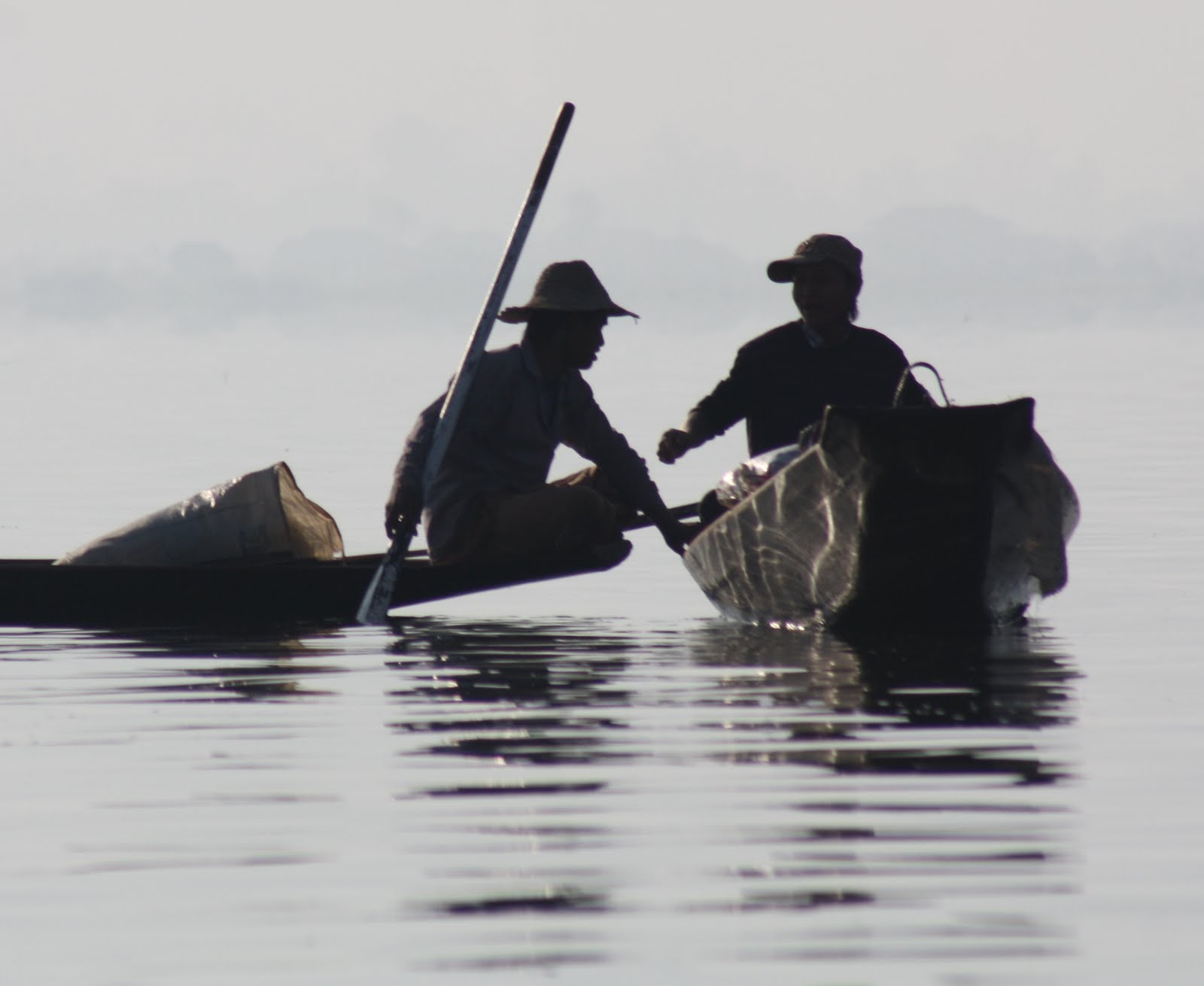
Fishers checked their nets and sunken baskets from wooden skiffs barely wide or deep enough to support them.
Boats were manoeuvred with incredible dexterity using the leg rowing method.
We stopped to talk to fishers, some of whom had slept overnight on the water in order to secure their catch of Inle carp, a staple of the local diet.

The “fish broker” was holding informal court in a collection of boats as tired fishers presented their catch for payment, the broker destined for the five-day market which rotates between the various lakeside communities. Serious horse trading was underway with fish and kyat, the Burmese currency, rapidly changing hands.

One fisher, cash in hand, stoked a small charcoal fire in a makeshift metal grate on his canoe to extract any remaining heat from the dying embers. He seemed satisfied with the morning’s proceedings.
In addition to fishing, the people of Inle Lake are able farmers, growing vegetables and fruit on extensive floating gardens. The garden beds, anchored by bamboo poles, are created from the nutrient-rich vegetation extracted from the lake bottom. The gardens rise and fall as the water level changes, making them resistant to flooding.
The economic reality of the daily catch from the lake and the harvest from the floating gardens to the local population was self-evident at the market we visited later in the day.
Over simplified perhaps, but just another ordinary day on Lake Inle.

Intha Leg Rowing - Not For The Unbalanced

A 50 minute flight from Yangon brought us to the airstrip at Heho. An hour-long drive followed over a bumpy, dusty road as we vied with ox carts and pick-up trucks crammed with people for our place on the narrow thoroughfare. Our final destination - Nyaung Shwe at the north end of Inle Lake.

It’s becoming a rarer and rarer experience, but now and again you have the good fortune to experience what can only be described as a “National Geographic moment”. It would actually prove to be a series of such moments over the next few days.

Inle Lake, situated at elevation and surrounded by the Shan Hills is home to the iconic Intha leg rowers. The technique involves standing at the bow or stern of a wooden canoe on one leg while wrapping the other around an oar. The rowing style evolved because the lake has thick vegetation and reeds at its shallows, as well as floating hyacynth and other varieties, making it difficult to see if one were to be sitting. The practice is restricted to males, women rowing in traditional style.

With 70,000 residents living in communities around the Lake Inle, most are Intha but there are also other ethnic groups including the Shan and the Pa-O, many of whom we were to see in their distinctive costumes at the local five-day market.

Most are devout Buddhists (some also hold animist beliefs in the cult of the 37 Nats or Spirits), and are self-sufficient farmers and fishers living in simple homes of wood and woven bamboo, often on stilts in the water.

Arriving in Nyaung Shwe we left our vehicle and boarded a long wooden motorized canoe with our guide Joe for the 45 minute ride to the Princess Resort across the Lake.

Our luggage tucked beneath an old blue tarp at the bow, we took our seats in modified wooden lawn chairs and sat back to enjoy the ride as the wake washed up alongside. Passing through several small lakeside communities, the locals repaired fishing nets or washed their water buffalo while the children waved enthusiastically.

As we neared the hotel, the boat’s motor was cut and a young boy hopped on board from a nearby dock and ably demonstrated one leg rowing as he guided the boat in silence to the hotel dock.

Not knowing what to expect in terms of accommodation or ambiance, I leave the pictures to tell the story.

Suffice it to say, we loved the novelty of the outdoor shower, the hot water bottles placed in our mosquito netted beds to ward off the nightly chill (its not cold for heaven's sake, we’re Canadian) and the locally produced Red Mountain Estate Sauvignon Blanc that ably complimented the Shan-inspired dinner.

And of course the sunset over the lake from our cabin's verandah wasn't shabby either.