Sunday, May 2, 2010

Behind the Shutters of Mindelo

What a contrast today had been. After visiting some of the poorest countries in Africa, the Cape Verde Islands provided a welcome relief and a prequel to the Caribbean Islands that await us over the next ten days.

Cape Verde is a group of rugged, volcanic islands located about 350 miles off the west coast of Africa.

Docking in the port city of Mindelo, it was a bright sunny Sunday morning and all was quiet except for the sounds of singing that came through the windows of the Church of the Nazarene, a small building just off the main square.

The buildings of Mindelo have a Portuguese charm to them - clay tiled roofs, pastel coloured walls and wooden shutters in various states of repair.

The swaying palms, bougainvillea and hibiscus seemed to soften the narrow streets, many of which are cobbled.

Down on the waterfront it looked as though Sunday was "dog bathing day". Locals took their canine companions on leashes into the bay, ruffling their coats in the salty water. Man and dog unified in their pleasure of the cooling water.

The sleepy feeling of this colourful town perhaps hides many a secret behind its shutters because the history of the islands is quite a story.


Portugal claimed the uninhabited islands for their empire in the 1400s, bringing enslaved Africans to work in their newly established sugar plantations.

Entrepreneurs and those seeking solace from religious persecution in Europe followed, adding to the potent ethnic mix one sees in today's residents. But its interesting that of the million or so Cape Verdeans, over one half live elsewhere in the world.

The Cape Verde Islands became independent in 1973 after a particularly nasty struggle in the jungles of Guinea-Bissau on the African mainland - an ultimately failed attempt to join both countries into one nation.

A far cry from today's sleepy Sunday morning as the colour of the buildings intensified in the morning sun and the shutters of its buildings slowly opened to let in another day.

Saturday, May 1, 2010

Banjul Eyes

Before coming on this trip I had no appreciation for the many small countries that make up Africa - in fact I'll be quite honest - I would struggle if I had to name even half.

The almost schizophrenic carving up of the continent by the colonial European powers in their day has resulted in the boundaries of the many countries that make up modern Africa. So, I suppose I can be forgiven for knowing next to nothing about The Gambia - the smallest country on mainland Africa. It looks like a finger jutting into Senegal, which shares its other borders. Gambia's own boundaries mirror the meandering Gambia River - a River that was of strategic importance during the infamous slave trade.

We docked in the port of Banjul, located on Banjul Island where the Gambia River enters the Atlantic Ocean. The wharf was long and narrow and across from our berth a series of fishing boats were tied up offloading impressive amounts of frozen tuna.

Beyond the dock gates, container traffic vied for position on the potholed dirt road leading out of the port while the craft marketeers gathered in full force, ready to set up shop on the dock once the port authorities gave the OK.


The most striking thing was the colour. The women's costumes and headdresses were so vibrant and many were wearing beautiful necklaces and earrings.

A predominantly Muslim country, the backdrop was the sound of mullahs calling the faithful to prayer - it was Friday.


Today's excursion was to take us out into the countryside to visit a school as well as a family who had opened up their home so that we could experience their communal lives. While Gambia's economy is dominated by farming, fishing and tourism, about a third of the population lives below the poverty line. This was all too evident as we drove through its largest city of Serekunda into the countryside.

Our mode of transportation was somewhat unique - described as "an open-sided four wheel drive that seats about 20 people" - the old converted army truck with its broken seats and thatched roof trundled down the road, throwing us this way and that as yet another pothole was negotiated.

Leaving the town, the road turned into a winding track and the countryside looked desolate. It was still the dry season and the rains were not due for another couple of months. Enormous termite hills flanked the roadway together with various vegetation.

Now and again we would brush against lime and cashew trees as we lurched from side to side over the uneven track. Dust clouded around us as another pothole was missed and errant branches thrashed the side of the vehicle, some dropping their leaves and fruit on us as we ducked to avoid a direct hit.

Eventually we arrived at the school, a compound originally built by the Dutch. The children ran to greet us and sang for us in their classrooms while their teachers explained the educational system.

It was clear that Gambia's educational infrastructure is severely under-resourced and that the school, like so many others, was relying on outside help. A crudely made donations box was passed around and it was with a feeling a great sadness that we saw the hopelessness of providing an educational system like the one we take for granted.

While close to half of the students in the primary school were girls, it was clear during our home visit that women are the providers and the glue that holds their large extended families together.

The men didn't appear to be particularly motivated. The large numbers of children that ran out to wave and yell wildly when they heard our vehicle coming was astonishing.

Returning to Banjul we followed a coastal road, passing a fishing community. The stench of raw fish was strong as well as a more fragrant smell coming from the peanut processing plant, Gambia's predominant export earner.

Back on the dock there was organized chaos as fellow passengers bargained in the makeshift market. The fisherman from the shipping alongside us watched lazily, some stretched out in wheelbarrows that had been used earlier in the day to transport the tuna haul.

All that seemed to be missing from the melee was the aroma of a camp fire or two and cooking food.

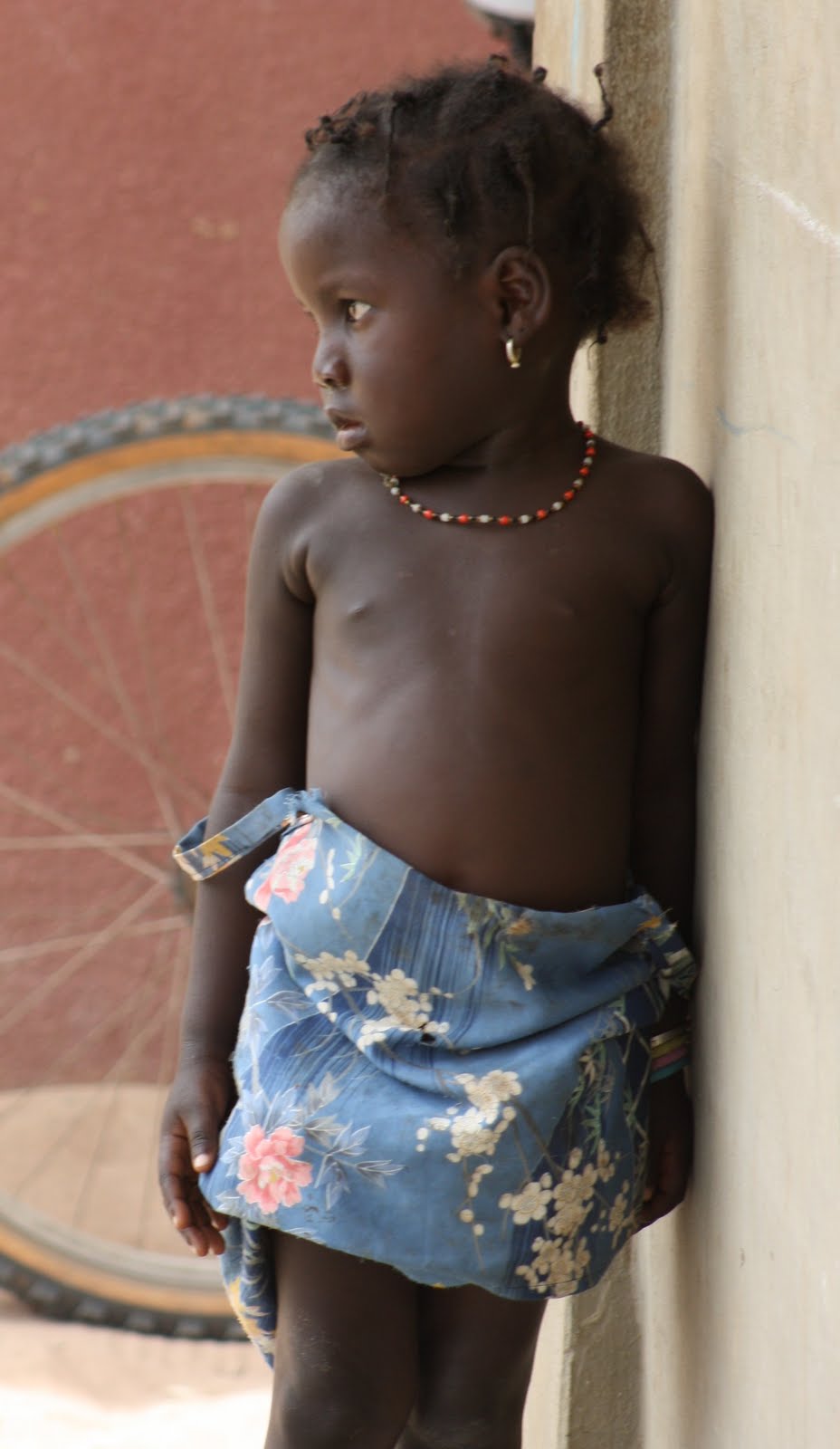
And then the scene would have been perfect, underscored by those haunting Banjul eyes.


Thursday, April 29, 2010

Dark Chocolate Is Good For You

While Cote d'Ivoire is reputed to be the world's largest exporter of cocoa beans, Ghanaians are quick to remind you that they too have held that title, but that their cocoa beans are of much higher quality.

Doug remembers going to the Cadbury's plant in Wallasey as a schoolboy on an educational tour and watching an old film that showed a derelict freighter being loaded in Ghana with large sacks of cocoa beans from dugout canoes hitched alongside. The cocoa was bound for processing in England. When the wind blew in the right direction the fragrant smell of chocolate from the Cadbury factory would waft into the house.

So here we were in Ghana - the port of Takoradi a much more modern facility that what that old movie had depicted. Today we were off on an adventure to the Kakum National Park and the Canopy Walkway, several hours drive from Takoradi which has the unusual honour of being the world's largest city closest to the Equator and the Prime Meridian - making it the most centrally located city in the world.

Takoradi and its deep water seaport is twinned with Sekondi, which combined, make the conurbation Ghana's fourth largest city and a vibrant industrial and commercial centre.

The drive revealed life. Homes were constructed in a ramshackle fashion with daily trading taking place at the roadside. We saw many interesting vendors - "Talent Mechanics" being one - and surely very popular given all the broken down vehicles we encountered during the day. "Wise Choice Financial Services" was another one that caught our eye - particularly since its signage announced that "it was opening soon". And who could not shop at the "God is Good Grocery Store"!

Nowhere in Africa has the impact of communications technology struck us quite so strongly. Vodaphone, MTN and Tico being the most common. Cellphone companies and Internet providers use the same tactic to promote their product. A homeowner or landlord is contacted and offered a contract which results in the home being painted in the enterprise's corporate colours.

First of all we thought all these colourful buildings were commercial outlets, but soon realized there were far too many of them for that to be the case. Vodaphone red was the most prevalent, standing out amongst the dreary collection of shacks and corrugated tin roofs.

Arriving at the Kakum National Park we were outnumbered by schoolchildren, there to walk the canopy. A fairly steep climb up uneven stone paved steps carved its way through the forest.

Butterflies flew around us and there was a cacophony of sound from the undergrowth. The sky was hidden but large rain droplets started to fall, stopping as soon as they had begun. Before long the sun had returned and the temperature soared.

Arriving at the canopy platform we saw the first of seven rope suspension bridges spanning the trees.

The walkway was nothing more than a series of planks attached to steel ladders suspended by rope netting.

It was higher than I had expected and looking down was something one did sparingly - we took the advice to look ahead to the end of the ropeway!


At the fifth landing we met a Ghanaian who told us the walkway had been built with the assistance of Canadians and that in his words "Canadians are very fine people".

We always travel with maple leaf pins and took the opportunity to make him an honorary Canadian. He smiled broadly revealing a number of missing teeth. He shook our hands, his chocolate coloured skin glistening in the humidity.

There were still two more stretches of swinging walkways to maneuver and we were glad when we eventually stepped foot on terra firma.

This was no Capilano Suspension Bridge, but our day in the Kakum will provide great material when we do our next North Shore tour.


When we returned to the port we could see large quantities of cocoa beans stacked ready for their journey to one of the world's processing plants. Its good news that the experts have determined that dark chocolate is good for you - that means a continuing supply of high quality beans from Ghana to the rest of the world.

From Togo's Beaches to the Premier League

When we were in Cape Town earlier on our trip, we enjoyed talking to the locals about the upcoming June FIFA World Cup in South Africa. We asked which was the best African team in the competition and the word on the street was Cameroon. I hadn't realized that most African players worth their salt play in the various elite European soccer leagues.

Fast forward to Togo. We had driven from the port city of Lome for a day out in the countryside to visit a bush school and a rural mountain village where we were welcomed personally by the Chief - a very tall, striking man who looked quite regal and comfortable in his role as his surrounding entourage performed a welcoming ceremony involved a dubious looking brew.

On the drive from the port we travelled past miles of waterfront flanked by deep yellow sand. It was Sunday morning and the locals were enjoying various activities on the beach, the most prevalent of which was soccer. Men sported various uniforms but were playing barefoot. We were told that this is how Togo produces such great soccer players - running and kicking in the sand is like extreme training for when the game is played on grass.

As we left the beach area and drove inland through rural Togo, every now and then a soccer pitch would manifest itself between the palms and cocoa plantations. And even though the temperature was in the high 30s with sweltering humidity, it was clear the game was the thing.

Our stop at the bush school was glorious. While it was Sunday, because of our visit, the teachers had given the children Friday off, making Sunday a school day on this occasion. Imagine being greeted by all those smiling faces and big curious eyes.

The various classrooms were doing their lessons and one by one, each class burst into song. The singing was so joyous and loud, bodies swaying and hands clapping.


This joyfulness continued when later in the day we visited the mountain village.

After the Chief's greeting the music started and the dancing followed. It was loud and happy and eventually many of us joined in. The clothing was so colourful and mothers carried their babies in a unique cloth device on their backs. Many of the babies slept peacefully even though their mothers were dancing vigorously.

Today was a day that reminded us that this is why we travel. While homes were no more than huts, and conditions basic, the people seemed so happy - perhaps as much bemused by our presence as we were by theirs.

While most Togoans are Christian who retain their indiginous belief in voodoo - there was no mistaking the universal religion of soccer - colourfully reinforced by the many international team shirts worn by the children. It goes without saying that the outcome of the World Cup will be watched in Togo with great interest.

Almost Benin

Well that was a close one. After four glorious days of sailing north from Namibia skirting the borders of Angola, Cameroon, Guinea, Congo and Nigeria we docked outside Cotonou harbour, the economic capital of the Republic of Benin.

We arrived just as the sun was rising in a humid, sultry sky.

Our morning walk of the decks had become a daily routine and as we looked out towards the harbour we could see no activity. A freighter was docked at our berth and there was no sign of the pilot. What followed was a long morning for Captain Mario who assured us that he, too, had been assured that the pilot would be on his way out to us soon. Despite the assurances “soon” proved to be an open-ended word not to be taken literally.

Eventually we were informed that the freighter had engine problems and could not leave the dock. This was followed by a further update half an hour later – the freighter's engine had apparently been restarted and the pilot was on his way to guide us into the harbour. And sure enough shortly thereafter, a white-gloved, uniformed official revealed himself from the pilot launch.

Despite freighters being moved, weather was not on our side. What had started out as a steamy, equatorial morning was changing fast.

Inky black clouds on the horizon were moving in at break neck speed towards us and the lazy ocean started to be lashed by the prevailing winds.

Soon there were generous white caps and the fishing boats around us, some no more than dug outs, turned back to port. The occupants bailed out their vulnerable vessels with brightly coloured plastic buckets as the waves crashed over them.


A frustrated Captain told us dejectedly that the port had now been officially closed until the winds died down but that once the front had passed, the pilot would guide us in to tie up. We were looking forward to our adventure on Lake Nokoue where we would travel to Ganvie – a village constructed on stilts.

Eventually the seas calmed but another storm was gathering on the horizon. In this part of the world darkness arrives at 6:00 p.m. and we were running out of daylight, so the decision was made to leave Benin and head west to Togo, our next port of call.

A country which in its colonial past was known as Dahomey, and which at one time had instituted an elite female soldier corps known as the “Dahomean Amazons” would continue to remain a mystery to us – at least for now.

Grains of Namibian Sand

It’s said that the former German protectorate of Namibia is the land God made in anger because of its harsh, desolate landscapes.

I had always associated Namibia with miles of endless sand dunes – and of course - the place where Brad and Angelina camped out to await the birth of their daughter.

The twenty-mile drive from the port of Walvis Bay to Swakopmund is spectacular. The paved road is flanked on one side by towering sand dunes with the Atlantic ocean on the other. Beaches are ominously scattered with shipwrecks. And yes, our driver pointed out the Burning Shore resort where Brad and Angelina stayed.

Turning east we made our way into the Namib Desert – no place to break down. A railway runs through the Desert from South Africa into Namibia and up into Angola and is important in the transit of goods, particularly supplies required in the mining of uranium – or yellow cake.

Driving in a convoy of four-wheel drives, our leader would halt our modern day wagon train periodically to point out rock formations and plant life – one of the most unusual species being the Welwitschia, a shrub-like plant which grows just two long strap-shaped leaves continuously throughout its lifetime.


The leaves can grow to be several meters long and become gnarled and twisted from the desert winds.

The plant has a science fiction quality to it and is pollinated by unusual looking insects. It is truly amazing that it survives the arid desert conditions at all - very efficient in the way it finds nourishment, sometimes deriving moisture from coastal sea fogs.

The Namib Desert is the world’s oldest living desert with moon-like landscapes and rocky enclaves worthy of a ready-made movie set for a Cowboy and Indian ambush.

The Desert is home to the world’s largest sand dunes which can shift anywhere between 6-9 feet a year, the second largest of which – Dune 7 – we were able to explore.


Dune 7 didn’t look that foreboding but to try the vertical climb to see the view from the top is more challenging than it looks. For every two steps forward, one retreats a little as sand pours into shoes and any other available opening on one's body. Cameras are particularly vulnerable, and luckily, we had remembered to bring a plastic bag to protect the camera body as much as it could.

The wind whipped up the summit of the dune, creating a temporary mini sand storm against a brilliant blue sky. The colours were amazing, changing in intensity as the sun moved across the sky. Halfway up the dune unable to control our laughter we realized that climbing to its summit was futile so we stopped to take in the view as it stood – sweeping landscapes of golden sand, sculpted by the wind into a Dali-esque beauty.

Climbing down the Dune was abandoned – we sat on our backsides and slid down. We must have walked back on board the ship each with a bucket of sand concealed in our shoes and clothing!

Believe it or not within the starkness of the desert we arrived at a clearing that had at one time been planted with olive trees – and underneath the foliage we were refreshed with sparkling South African wine and Walvis Bay oysters in the half shell.

Sand and all, yet another memorable day.