Thursday, April 29, 2010

From Togo's Beaches to the Premier League

When we were in Cape Town earlier on our trip, we enjoyed talking to the locals about the upcoming June FIFA World Cup in South Africa. We asked which was the best African team in the competition and the word on the street was Cameroon. I hadn't realized that most African players worth their salt play in the various elite European soccer leagues.

Fast forward to Togo. We had driven from the port city of Lome for a day out in the countryside to visit a bush school and a rural mountain village where we were welcomed personally by the Chief - a very tall, striking man who looked quite regal and comfortable in his role as his surrounding entourage performed a welcoming ceremony involved a dubious looking brew.

On the drive from the port we travelled past miles of waterfront flanked by deep yellow sand. It was Sunday morning and the locals were enjoying various activities on the beach, the most prevalent of which was soccer. Men sported various uniforms but were playing barefoot. We were told that this is how Togo produces such great soccer players - running and kicking in the sand is like extreme training for when the game is played on grass.

As we left the beach area and drove inland through rural Togo, every now and then a soccer pitch would manifest itself between the palms and cocoa plantations. And even though the temperature was in the high 30s with sweltering humidity, it was clear the game was the thing.

Our stop at the bush school was glorious. While it was Sunday, because of our visit, the teachers had given the children Friday off, making Sunday a school day on this occasion. Imagine being greeted by all those smiling faces and big curious eyes.

The various classrooms were doing their lessons and one by one, each class burst into song. The singing was so joyous and loud, bodies swaying and hands clapping.


This joyfulness continued when later in the day we visited the mountain village.

After the Chief's greeting the music started and the dancing followed. It was loud and happy and eventually many of us joined in. The clothing was so colourful and mothers carried their babies in a unique cloth device on their backs. Many of the babies slept peacefully even though their mothers were dancing vigorously.

Today was a day that reminded us that this is why we travel. While homes were no more than huts, and conditions basic, the people seemed so happy - perhaps as much bemused by our presence as we were by theirs.

While most Togoans are Christian who retain their indiginous belief in voodoo - there was no mistaking the universal religion of soccer - colourfully reinforced by the many international team shirts worn by the children. It goes without saying that the outcome of the World Cup will be watched in Togo with great interest.

Almost Benin

Well that was a close one. After four glorious days of sailing north from Namibia skirting the borders of Angola, Cameroon, Guinea, Congo and Nigeria we docked outside Cotonou harbour, the economic capital of the Republic of Benin.

We arrived just as the sun was rising in a humid, sultry sky.

Our morning walk of the decks had become a daily routine and as we looked out towards the harbour we could see no activity. A freighter was docked at our berth and there was no sign of the pilot. What followed was a long morning for Captain Mario who assured us that he, too, had been assured that the pilot would be on his way out to us soon. Despite the assurances “soon” proved to be an open-ended word not to be taken literally.

Eventually we were informed that the freighter had engine problems and could not leave the dock. This was followed by a further update half an hour later – the freighter's engine had apparently been restarted and the pilot was on his way to guide us into the harbour. And sure enough shortly thereafter, a white-gloved, uniformed official revealed himself from the pilot launch.

Despite freighters being moved, weather was not on our side. What had started out as a steamy, equatorial morning was changing fast.

Inky black clouds on the horizon were moving in at break neck speed towards us and the lazy ocean started to be lashed by the prevailing winds.

Soon there were generous white caps and the fishing boats around us, some no more than dug outs, turned back to port. The occupants bailed out their vulnerable vessels with brightly coloured plastic buckets as the waves crashed over them.


A frustrated Captain told us dejectedly that the port had now been officially closed until the winds died down but that once the front had passed, the pilot would guide us in to tie up. We were looking forward to our adventure on Lake Nokoue where we would travel to Ganvie – a village constructed on stilts.

Eventually the seas calmed but another storm was gathering on the horizon. In this part of the world darkness arrives at 6:00 p.m. and we were running out of daylight, so the decision was made to leave Benin and head west to Togo, our next port of call.

A country which in its colonial past was known as Dahomey, and which at one time had instituted an elite female soldier corps known as the “Dahomean Amazons” would continue to remain a mystery to us – at least for now.

Grains of Namibian Sand

It’s said that the former German protectorate of Namibia is the land God made in anger because of its harsh, desolate landscapes.

I had always associated Namibia with miles of endless sand dunes – and of course - the place where Brad and Angelina camped out to await the birth of their daughter.

The twenty-mile drive from the port of Walvis Bay to Swakopmund is spectacular. The paved road is flanked on one side by towering sand dunes with the Atlantic ocean on the other. Beaches are ominously scattered with shipwrecks. And yes, our driver pointed out the Burning Shore resort where Brad and Angelina stayed.

Turning east we made our way into the Namib Desert – no place to break down. A railway runs through the Desert from South Africa into Namibia and up into Angola and is important in the transit of goods, particularly supplies required in the mining of uranium – or yellow cake.

Driving in a convoy of four-wheel drives, our leader would halt our modern day wagon train periodically to point out rock formations and plant life – one of the most unusual species being the Welwitschia, a shrub-like plant which grows just two long strap-shaped leaves continuously throughout its lifetime.


The leaves can grow to be several meters long and become gnarled and twisted from the desert winds.

The plant has a science fiction quality to it and is pollinated by unusual looking insects. It is truly amazing that it survives the arid desert conditions at all - very efficient in the way it finds nourishment, sometimes deriving moisture from coastal sea fogs.

The Namib Desert is the world’s oldest living desert with moon-like landscapes and rocky enclaves worthy of a ready-made movie set for a Cowboy and Indian ambush.

The Desert is home to the world’s largest sand dunes which can shift anywhere between 6-9 feet a year, the second largest of which – Dune 7 – we were able to explore.


Dune 7 didn’t look that foreboding but to try the vertical climb to see the view from the top is more challenging than it looks. For every two steps forward, one retreats a little as sand pours into shoes and any other available opening on one's body. Cameras are particularly vulnerable, and luckily, we had remembered to bring a plastic bag to protect the camera body as much as it could.

The wind whipped up the summit of the dune, creating a temporary mini sand storm against a brilliant blue sky. The colours were amazing, changing in intensity as the sun moved across the sky. Halfway up the dune unable to control our laughter we realized that climbing to its summit was futile so we stopped to take in the view as it stood – sweeping landscapes of golden sand, sculpted by the wind into a Dali-esque beauty.

Climbing down the Dune was abandoned – we sat on our backsides and slid down. We must have walked back on board the ship each with a bucket of sand concealed in our shoes and clothing!

Believe it or not within the starkness of the desert we arrived at a clearing that had at one time been planted with olive trees – and underneath the foliage we were refreshed with sparkling South African wine and Walvis Bay oysters in the half shell.

Sand and all, yet another memorable day.

Skies Over Africa - Cape Town Revisited

We were into the tenth hour of the overnight flight from London to Cape Town and there were signs of the coming dawn through the window.

The black sky was slowly being illuminated on the far horizon by strands of strawberry, orange and scarlet, reflecting on the aircraft's wing. It was going to be a spectacular African sunrise.

It had been eleven years since our last visit to South Africa and we were looking forward to seeing Cape Town again.

The British Airways 747 swung out over the ocean as it made its final approach and before we knew it we were on the ground making our way into the terminal building. It was 8:00 a.m. local time and we were the only incoming flight - a far cry from the organized chaos of London Heathrow where gates are not even assigned until 45 minutes prior to boarding, such is the volume of air traffic.

Several days later, as Iceland's unpronounceable volcano spewed clouds of ash into the atmosphere shutting down all European airports, we shuddered at what it must have been like at Heathrow. We were just grateful to have arrived at our destination.

Our flight was early and there was no sign of our driver, but within minutes he appeared, loading us up efficiently in his comfortable new Volvo for the drive to the hotel. We were far from our best after two overnight flights.

It was only twenty minutes away but traffic was at a standstill, such was the volume of commuters making their way into Cape Town from the townships and suburbs. The N2 is a major highway and we were a little unnerved to read several days later that car muggings on the highway have become a problem......


We arrived at our Victoria and Alfred waterfront hotel to a warm welcome. Even though it was now 9:30 a.m. our room was ready. The view from our room over the harbour and Table Mountain was picture perfect.

The V&A hotel is a converted warehouse that was originally used as a storage and customs facility by the Union Castle Steamship company out of Liverpool - now beautifully restored to showcase its original architectural features. We spent the next two days enjoying the waterfont, its shops and outdoor restaurants.

Seven Seas Voyager was scheduled to arrive the next afternoon - and what a beautiful sight it was to see its bow sliding silently into the harbour. Everyone standing on the waterfront paused to watch the spectacle.

After boarding the next afternoon, we spent a further day in Cape Town at dock before setting sail for Walvis Bay, Namibia.

Happy to have been able to visit Robben Island and the winelands of Paarl, Stellenbosch and Franschhoek during our brief stay, we settled on our balcony with champagne in hand as Voyager slipped her moorings.

The setting sun coloured the sky over Table Mountain and Cape Town's new waterfront soccer stadium which will host one of the World Cup's semi-finals in June.

And "oh the thrill" as yet another adventure begins!

Sunday, March 7, 2010

Time For The Circus To Move On


Hard to believe that on 21 March at the conclusion of the Paralympic Games it will all be over.

Vancouver’s Olympic Games started with the horrifying death of an athlete and was followed by a series of glitches, none of which was lost on the British press. That venerable institution, The Times ridiculed Canada’s “Calamity Games”, but as time went on was forced to soften its tone as the Games got into stride. The rest, of course, is history.

And then there is Sochi, the Black Sea port city that will host the next Winter Olympics in 2014. Russia, uncharacteristically, had a poor medal showing at the Vancouver Games with the Russian President abruptly cancelling a scheduled visit to the closing ceremony, apparently in disgust. Their hockey team’s showing must have been the final straw.

“The Canadians came on to the ice like gorillas out of a cage” – supposedly a quote from the Russian goaltender. Canada won convincingly and the Russian superstars looked as though they were in shock.

Many of the Russian contingent I met in Vancouver didn’t smile a lot or spend much time on the usual pleasantries. In fact it became a bit of a game for me, as I tried to make eye contact and get a smile. The day of the Canada/Russia hockey game I smiled to those who met my gaze and muttered “Go Canada Go ---- but may the best team win”. Not much reaction.

The next morning I saw the same group of people, and one of the more stoic, took my arm and squeezed it slightly – “Your team better” he grimaced seriously.

Science World was Sochi House for the duration of the Games. The line up for the pavilion was long but people around us chatted amiably. It was a Spring-like day and there was lots to talk about as we slowly reached the entrance.

Once inside a young lady explained where Sochi was – most of the crowd didn’t seem to realize it was on the Black Sea. Movies were being shown, in Russian. Folk singers were in full voice, entertaining an appreciative crowd.

And then we went to the shop where official, and extraordinarily expensive, Russian team merchandize was on sale.

One of the other “must sees” during the Olympics was the Russian tall ship Kruzenshtern docked at Lonsdale Quay.

The Kruzenshtern, built in Germany in 1926, is one of the tallest sailing ships in the world and had to enter Vancouver's inner harbour at low tide.

This enormous vessel was absolutely magnificent and the Vancouver skyline provided a stunning backdrop that sunny afternoon. And yet while ship tours were being offered little English was spoken.

What a missed opportunity to learn more about one another - some good old fashioned PR would definitely have helped the cause.

So as the Olympic flag was passed between Vancouver and Sochi Mayors and the Moscow State Chamber Choir sang a stirring rendition of the Russian Federation anthem, I wondered what the next few years would bring as Sochi, and London, prepare for their "big shows".

When the circus comes to their respective towns in 2012 and 2014 I wish London and Sochi well - in their hearts they know that Vancouver 2010 set the gold standard and will be a very hard act to follow.

Wednesday, March 3, 2010

Golden Moments, All Fourteen Of Them

When Alexandre Bilodeau won gold in the men's moguls, you could almost feel the collective relief expressed by every Canadian - finally the curse of Canada never having won gold on home soil had been lifted.

And indeed it would have been soil had the Organizing Committee not been forced to truck in snow from Manning Park to keep winter on Cypress Mountain, fighting nature and one of the warmest winters on record. But they did it.

And the gold medals kept on coming.

But perhaps the sweetest golden moment of all was on the final afternoon of the Games.

The gold medal hockey game was the one we desperately wanted to win and if Canada had only managed to win one gold throughout the entire Games, this had to be it.

Canada's progress to the final game had been a nail-biting experience and this did not let up. As we watched Canada battle the USA in the winner take all final, stress levels mounted. And when the TV ratings were revealed it appears that practically everyone in the country had been compelled to stop what they were doing to watch and will the right outcome.

During a break in the coverage a panoramic view of Vancouver flashed across the screen and the announcer remarked on the eerie quietness of the city that sunny Sunday afternoon - where were all the people he pondered - where do you think .....

Thank you to the hockey gods for putting us out of our misery, even though the game went to sudden death overtime!

It was a fitting end to what had been a wonderful Winter Games on so many levels.

The zip trek lines that started before six in the morning, three hours before opening time at Robson Square.

Hudson's Bay Fever, as people lined three and four deep around the store to purchase their Olympic merchandise - who could leave town without a pair of those iconic red mittens.

Three to eight hour long waits, depending upon your line-up strategy, to get into the Mint's medal room to see and touch the Olympic and Paralympic medals.

The medals, worth about $1.8 million, based on current metal prices, depict contemporary First Nations artwork of an orca and a raven. Each medal is one of a kind, displaying a section from the artwork. Picking the medals up with special cotton gloves, we were surprised to find them heavy, wavy and spectacular.

In our easy going city, where walking along the seawall near Science World - or Sochi House during the Games - two familiar faces passed us in Team Sweden uniforms - Messrs Sedin and Ohlund were deep in conversation. But no one paid attention to these beloved hockey stars, how very Canadian.

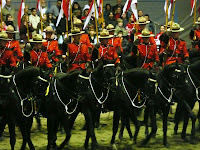
The friendliness of the horses and the riders in Canada's fabled RCMP musical ride - one of the highlights of Surrey's Olympic Celebration Site at Holland Park.

And the sea of red and white everywhere, impromptu renditions of our National anthem and street hockey games that seemed to break out in exuberant moments of pure joy as another medal was nailed down by Team Canada (in addition to 14 gold, we managed 7 silver and 5 bronze medals).

Even our financial institutions jumped on the bandwagon with this amusing banner - and yes - RRSP deadline is looming fast.

Neil Young's "Long May You Run" was a fitting refrain as the Olympic flame was extinguished during the Closing Ceremony at BC Place. The flame in the cauldron on the waterfront expired at the same time - people remarked that if you had blinked you would have missed the moment.

And then the spectacle was over and it was time to draw breath on this escape from our collective realities.

To our Canadian Olympic athletes, you did us proud. Thank you. Now it's time for our Paralympians to take centre stage and compete for their own golden moments. I can hardly wait.

Monday, February 15, 2010

Not Very Canadian, Eh?

The Olympic Cauldron will become a permanent landmark on Vancouver's waterfront after the Winter Games are over at the end of February.

A magnificent structure in a spectacular setting – no doubt about that.

The Olympic flame which Wayne Gretzky used to ignite the outside cauldron (a ceremonial cauldron was also lit within BC Place Stadium) began its journey to Canada from Olympia, Greece some months ago after much pomp and ceremony.

After its arrival in Canada, the flame journeyed across the country and back through the longest domestic torch relay in the history of the Olympic Games. The relay inspired many – embodying the purpose of the Olympic flame – which is supposedly an ancient representation of peace, friendship and brotherhood.

Watching much of this activity on television, we were keen to see the Cauldron aflame for ourselves and savour the moment but were disappointed to find it secured by ugly chain link fencing.

Everyone around us hoping for that experience too also expressed their disappointment. All resorted to using what means they could to get a picture through the fencing.

“Its those protesters, they spoil it for everyone” was the explanation of the sole RCMP officer on the other side of the fence - a delightful lady from Halifax whose temporary home along with the other security forces is one of the cruise ships docked at Ballantyne Pier.

In one of life's ironies that day I mention “The Mechanics of Man” Leonardo Da Vinci’s priceless pen and ink drawings of the human body. These 500 year old drawings are part of Queen Elizabeth’s permanent collection at Windsor Castle and on loan to the Vancouver Art Gallery.

Apparently Da Vinci’s drawings are still used as reference in sports medicine today – such is their intricacy. And we were able to get up close and personal, touching - admittedly through glass - but nevertheless feeling as though a connection could be made with the creations of a genius.

No such connection could be made at the site of the Olympic Cauldron though.

The chain link fence isn’t the Berlin Wall - but really - it has to come down. What are we afraid of with all that security in town. This IS Canada after all!