Tuesday, January 5, 2010

Harp Scratchings 12 - Rice Pudding fixes all ills

That annual six-week summer school holiday seemed to go on forever. It rarely seemed to rain - meaning that I could spend much of the time outside.

At least that is how I remembered it.

Astride Trigger, full of smiles before "the incident"

Summer brought many visitors to Glasbury-on-Wye who were on the scenic route to West Wales or to the border country and its “black and white” villages. The whitewashed cottages with exposed black beams and pretty gardens always pleased.

It meant more bed and breakfasters at the Harp or hungry travellers calling in for a snack and a pint.

There would often be a conspiratorial look between the locals when a new face came through the bar door but it was amazing how quickly Pricey, Burt or one of their companions could overcome their suspicions and shyness. Recognizing a suitable audience was is their midst, with lightning speed the poor unsuspecting patron would be regaled with stories of life in the village or local views on some recent event.

However, the entertainers would often become the entertained when the stranger, obviously bemused, or even amused, by the unsolicited information offered to buy a round which encouraged them all the more.

I loved walking on the Grove with Sweep and Tina, our sheepdog and corgi, or playing in the meadow across from the Harp.

Sometimes Dad would allow a local farmer use of the meadow to graze his horse. I was allowed to ride Trigger once or twice, although on the last occasion unbeknownst to me the reins rubbed a sore on Trigger’s neck. Fed up, he reached around and bit me hard on the thigh. I dismounted quickly and ran home crying from the shock of an otherwise even-tempered old grey being so unkind to me. I hadn’t realized I had hurt him. Days later the impression of Trigger’s teeth marks and an angry black and yellow bruise decorated my leg.

The meadow, aside from providing home for one our chicken coups, provided grazing for Ruby and Minstral, our Herefords, and a change of scene for our sheep when foraging on the Grove became difficult, or when it was high water.

One summer the local Scout troupe approached Dad because they were looking for a site to accommodate a visiting group who would camp overnight and then canoe on the River Wye. This became a regular occurrence over the summer and it was fun to meet other kids with strange accents from all over the country, and some from overseas.

While the sun seemed to shine on my childhood memories most of the time I remember one particular summer when its rays deserted us. That summer the heavens opened and it poured for days on end. The campers in the meadow made the best of the situation, practicing their survival skills, but that soon wore thin when the weight of the pooling rainwater collapsed one of the tents.

Mum took pity on the group and invited them into the top bar after closing to warm up. Despite the fact it was July, a coal fire had been lit to warm the bar.

The boys, from Birmingham, and their teacher trudged in dejectedly, arranging their wet clothes over chairs and benches to dry out. A steamy haze soon rose from the wet clothing in the warm bar and in preparation for this act of kindness Mum had considered what else she could do to ”warm them up”.

The answer lay in a hot pudding, but not one of her steamed jam or treacle suet puddings because it would have taken too long to prepare. It would be a rice pudding made from Ruby’s whole milk and baked in the oven until the rice was thick and creamy and the skin that formed on the top of the pudding had taken on an ebony hue. Some might venture to say burned.

The chatter in the bar quietened as Mum entered from the kitchen with me in tow carrying bowls and spoons. Ladling out the healthy goodness for the boys, you could hear a pin drop in the bar. Either they had never seen rice pudding before (did they even have it in Birmingham I wondered) or had they tried it and decided they didn’t like it.

The boys accepted the steaming bowls reasonably politely although facial expressions revealed their true feelings. Rice pudding was not kid food and they probably thought the pork pies, cornish pasties, pickled onions and crisps on the bar counter more appealing. However, the boys kept their thoughts to themselves as the teacher gave them a very long hard look. “Thank you Mrs. Price“ he said. “This is so good of you and I am sure the boys are very grateful. Aren’t you boys.”

“Yes” they reluctantly murmured.

I don’t remember if the rain ever stopped for the group's camping expedition, but next morning the still-damp gear had been packed ready for the canoeing trip ahead. Walking in single file the boys accessed the river from the meadow through the barrel dray and the garden.

Watching them from the kitchen window Mum probably thought that a tumble into the river couldn’t get them much wetter than they already were - but thanks to the rice pudding she knew they would be warm on the inside.

Sunday, December 13, 2009

Slipsliding Away on Dog Mountain

The stereotype of a French-accented fur trapper named Jacques, sporting a red plaid jacket, trudging feverishly through the snow on footwear resembling tennis rackets was my vision of snowshoeing.

The whole notion has a pioneering quality about it – even a romantic sentiment. With Christmas a few weeks away, it seemed like an appropriate time to try it out.

So it was with some amusement that we were introduced to modern-day snowshoes – slick looking, light-weight contraptions with rubber straps that adjust comfortably over one’s hiking boots with metal cleats on the underside acting as temporary anchors in the snow.

Arriving at the top of Mount Seymour with adjustments made to our footwear, all that was left to do was walk to the Dog Mountain Trail.

The first thing I learned about snowshoeing was putting trust into action.

The trails had been blanketed in snow but after a week of freezing temperatures and no fresh snow, the ground was icy. This was no flat, wide trail – it was undulating, winding and quite narrow in parts.

My snowshoeing technique needed immediate honing. This meant trusting that the cleats on the underside of the snowshoe would hold me in place as I made my way forward.

Once in stride we found ourselves taking the time to look and enjoy the natural environment around us. It was snowing very lightly and amazingly quiet.

After a kilometre we reached First Lake, frozen over, but with the tell-tale signs of other snowshoers and hikers.

Eventually we reached the rocky summit of Dog Mountain. Despite the wintry day, the view over the North Shore mountains and the City below was breathtaking - Stanley Park, Lions Gate Bridge and Point Grey clearly visible.

The buildings of the downtown core looking amazingly static. It was as though the city was devoid of people, and just a series of concrete statues.

The reality we knew was that down there in the metropolis it would be a cacophony of humanity in search of that perfect gift. Parking lots would be full to overflowing, people walking the streets with a glazed look on their faces. The joy of Christmas.

Up here on Dog Mountain the air was fresh, the vista below us a reminder of the world we had temporarily left behind.

Eating our lunch at 10:00 a.m. we greeted other snowshoers and their dogs and began the return trip. For some reason my trust of metal cleats had temporarily left my consciousness. I fell a few times on the downhill portions of the trail. Our leader reminded me to stand tall and look forward. I did, and eventually we returned to the ski hill and the parking lot.

With aching joints from the day’s activities I will admit to a slight mal de raquette – but oh the pure joy of being out there.

Jacques would have been proud.

Tuesday, December 8, 2009

Harp Scratchings 11 - One in a Million

I was six years’ old and my sister had just been born. Mum and Eileen Dawn Julia were in Summerfield Nursing Home and Auntie Wina had come to the Harp to help out.

I was thrilled to have a baby sister and with Wina’s encouragement made great pains to write to Mum about it, telling her that all was well at the Harp and that I was getting regular bedtime stories.

Probably one of my first recollections during that stay was the morning I asked Wina to put a blue ribbon in my hair. Standing in the kitchen I remember her patiently taking a few stabs at creating the perfect bow before I was satisfied.

On future visits to the Harp, Wina and Ernie would often bring vegetables from their expansive garden - or sometimes a very special treat - a home-made coffee sponge cake with icing that melted in your mouth.

As I grew up I loved going to stay with Wina and Ernie at Rectory Cottage in Eardisley. While “the Cottage” was one end of a large rambling residence adjoining Eardisley Church, their home consisted of oversized rooms with high ceilings, a wooden staircase and upstairs floorboards that squeaked and groaned as you walked across them.

It was an adventure to stay there, and sometimes when no one was looking I would cautiously turn a doorknob on a door that had been permanently locked as the dividing line between the Cottage and the Rectory itself – half hoping someone had unlocked the door and I could investigate what lay behind it.

I remember summer’s evenings when it seemed to take forever to get dark. Lying in bed I would listen to the church clock strike the hour.

One memory firmly entrenched in my mind is the episode of the cheese rind. Sitting down to supper with Wina and Ernie, Ernie had carefully pared away the rind from the cheese I had been offered. Not realizing, I chose the rind instead of the cheese and spent the next few minutes trying to chew what seemed like a piece of leather. When this was discovered, Ernie and Wina teased me quite a bit and the cheese rind story stuck for a number of years.

When her husband, Ernie was alive, the pair did so much for the family. I will always remember returning home from Toronto. Ernie came to Liverpool to meet me from the Empress of Canada.

I was so happy to see the family that in the excitement I left one of my suitcases behind in the luggage hall. We were halfway through the Mersey Tunnel before I made the discovery, and Ernie in true fashion didn’t miss a beat, turning the car around and returning to the dock to retrieve the missing bag.

Time went by, as it does. I returned to Canada where I have lived for most of my life. The baby in Grannie's arms - this was a christening picture - now lives with his own family in New Zealand.

Auntie Wina is in her nineties now and has outlived her siblings. Despite the frailties of age, she maintains a positive attitude and continues to be an inspiration to everyone who has the good fortune to meet her. I am so grateful she was there for me when I was growing up.

Just feast your eyes on a very classy lady attending the wedding this year of the daughter of good friends and next door neighbours, Paul and Sue.

Wina, you are one in a million.

As a postscript, it is with great sadness that we mark 29 March 2011 as the day Wina slipped away. Rest in peace dear one.

Tuesday, November 24, 2009

All Aboard the Taj Express!

It was early and already the heat of the sun radiated through the dust, creating a milky haze over the city.

We made our way slowly through the traffic to the railway station entrance, weaving through other travellers, hawkers and those who had nothing better to do than just watch. With tickets in hand we pressed on along the platform and over the railway bridge to our awaiting train, the Taj Express.

The train, scheduled to leave at 7:15 a.m. was already packed with people on wooden seating, their faces pressed against the metal grills of the open air windows. While our section of the train was allegedly air conditioned, a worker patrolled the aisles periodically, menacingly tapping a screwdriver against the rusting pipes in the ceiling.

The train pulled out of New Delhi on time and an open window at the end of the compartment acted like a viewfinder on the passing landscape. The "express" made several stops along the way allowing us to take in the activity on the always crowded platforms.

Food sellers touted their wares cooked on makeshift grills and char wallahs poured their tea into earthenware pots to grateful customers, chatting loudly amongst themselves twenty to the dozen. After several hours we reached Agra and the highlight of our trip - the Taj Mahal.

We have all seen pictures of the Taj Mahal, the mausoleum constructed by Shah Jahan in 1631 in honour of his favourite wife, Mumtaz, but nothing prepares you.

As one approaches, the building's actual size becomes apparent, seemingly built as an optical illusion on the banks of the Yamuna River.


We walked towards the perfectly formed ivory-coloured shrine through the gardens. Before we climbed the steep stairs to the mausoleum we donned cotton shoe covers and went inside to view the exquisite marble screen inlaid with semi-precious stones which surrounds replicas of the tombs of Shah Jahan and Mumtaz Mahal. The actual tombs lie below ground level.

In the Yamuna River below, water buffalo lazed while locals busied themselves with laundry. Upriver, the Red Fort glowed in the afternoon sun.

As the sun began to fall from the sky we returned to the Taj Mahal and took up our places in the gardens to watch the glow of the setting sun against the marble dome and its minarets. Many others were doing the same and a silence came over the crowd as if transfixed in their thoughts at the spectacle before them.

The planned early morning train trip back to Delhi the next morning was scratched because of a broken down locomotive so we clambered on board a bus for the five-hour drive. Before doing so, some of us took the opportunity to watch dawn break over the Taj Mahal. Below us, two hurriedly assembled cricket teams battled in the early morning light. A peacock strutted and scratched its way through a ruined building. Pinkish red bougainvillea framed many a picture as the impact of the sunrise's changing light and the noise of an awakening city set the scene.

All aboard the bus, we journeyed through Agra's early morning rush, passing schoolchildren on their way to their day's lessons, transported on motorized rickshaws and bikes. Men cycled with containers strapped to their mode of conveyance - some had collected milk from various farms and were delivering it to market for sale.

General chaos reigned, horns constantly blowing, every description of hand and animal drawn cart criss-crossing the road transporting sugar cane, hay, blocks of marble, dung cakes and people. The road, which was in the process of being widened felt like a battlefield with drivers happy to play chicken with the oncoming traffic.

A far cry from the serenity of the final resting place for Shah Jahan and his beloved wife.

Monday, November 23, 2009

Auckland New Year

In planning our trip to New Zealand, something had caught our eye - small yacht charters that take travellers out for a jaunt in Auckland’s harbour.

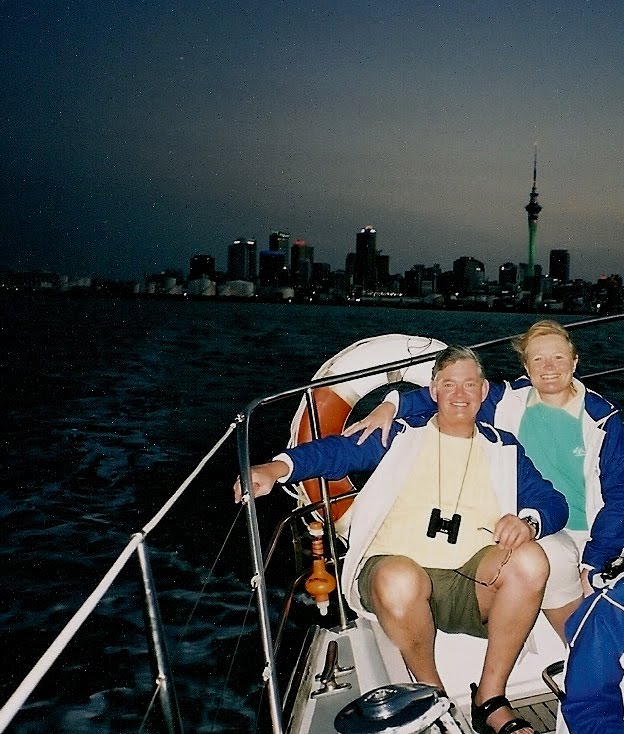
It was a glorious evening that New Year’s Eve and as we motored away from the dock we looked back on another memorable Auckland attraction – the Maritime Museum.

There were 17 passengers of various nationalities on the Pride of Auckland that evening and we all took turns manning the helm and trimming the sails. We dropped anchor for dinner and sipped wine, exchanging stories with our travelling companions.

After dinner, we sailed under Auckland’s harbour bridge, coming about to return into the main harbour. It was now dark and the skyline quite beautiful. It was still a few hours before midnight, but the excitement of the day had caught up with us and we went back to our hotel.

We had a rude awakening some time later when we shot up in bed to flashing bright lights strafing our hotel walls. A spectacular fireworks display had begun atop the Sky Tower at midnight, across the street from our hotel. Dubbed “Moulin Rouge” by the locals, we moved to the window and enjoyed a ringside view of Auckland’s New Year’s Eve light show. Over 35,000 people were on the streets below doing the same thing. We must have been dead to the world until our awakening - there was no mistaking the fireworks and cheering crowd.

If you find yourself in Auckland and have limited time, the Maritime Museum is a must.

A few hours wandering around the various displays will give an appreciation of the importance of the sea in New Zealand’s history – from early Polynesian navigators to whaling ships and the mass immigration of the 20th Century. Pride of place is also given to celebration of New Zealand’s America’s Cup victory and the life (and untimely death) of Sir Peter Blake, Black Magic’s captain.

A short distance from the Maritime Museum is one the Auckland’s most beautiful buildings – the Ferry Building.

Nowadays this 1912 Edwardian baroque building is the focal point for commuter ferries. Devonport, one of Auckland’s north shore suburbs is a short ten-minute ferry ride away.

Waiheke Island is also worth a visit - and we discovered that the ferry ride alone was worth the visit. On New Year's Day we enjoyed the white sandy beaches overlooked by cottage vineyards.

New Year’s holiday is a day for Aucklanders to pack a picnic, hop the ferry to Waiheke and laze the day away on the beach. It was fun being wrapped up in that atmosphere. We were on to do more serious things – explore three of the Island’s boutique wineries. Set among trailing roses, lavender bushes and olive trees it was an enjoyable afternoon.

Shades of England as we stopped for a lunch break – the tinkle of the ice cream van, meat pies, fish and chips – and the mainlanders enjoying their day out. We partook of the meat pie – bad decision after Doug renamed his snack dog meat pie.

We rejoined the holiday hordes for the return ferry trip to downtown Auckland and after a refresh at the hotel, it was time to eat. We found a backstreet Indian restaurant with friendly, talkative owners, non-stop Bollywood movies on the TV and a Maharajah’s banquet to die for.


On our way back to the hotel we experienced what nutty Kiwis have become famous for. Four insane people were strapped in a device resembling a sofa. A sort of reverse bungee jump had been set up in a car park.

Moments later the device hurled the screaming group into the air and we were left staring along with other passersby, wondering why. It didn’t look very safe, but Auckland is the city where people bungee jump off the Sky Tower for entertainment whether or not its a New Year's dare.

Terracotta Army – Silent Sentinels


As the story goes, in 1974 five farmers were working in the collective excavating for a new well.

In doing so, they unearthed the broken fragments of what was a silent army. Having no appreciation for their find, the farmers discarded the broken terracotta but kept the unearthed bricks that formed the base on which the famed Terracotta Warriors had once proudly stood to build pig pens.

The rest of course is history. The archaeologists moved in and the farmers became famous.

Over 2000 years ago several hundreds of thousands of workers spent 3 years constructing the Terracotta Army that was subsequently destroyed and plundered. The Army’s resting place is located near the Mausoleum of Emperor Qin Shi Huang.

A visitor to the Museum today will see many of the figures restored and exhibited in a hall built above the excavation site. Figures are grouped in battle order, rank by rank, some alongside horse-drawn chariots. Others are in infantry groups armed with spears, swords and crossbows.


Vault 1 houses 6000 life-size warriors, chariots and horses. Vault 2 contains formations of soldiers as the flank force and Vault 3 illustrates military headquarters.


The first sight of the contents of Vault 1 rendered us all speechless. The scale was much more expansive than we had expected. In fact there was a sense of occasion somehow as we looked down on those 2000 year old warriors so perfectly lined up, silent yet seemingly ready for battle.


At the Museum one of the farmers who had made the discovery posed for photos and autographed absolutely anything so long as it had been purchased in the Museum shop. However, local entrepreneurs looking for part of the action had managed to get beyond the security point into the Museum complex and were actively marketing their own crude version of the warriors. What the figures lacked in quality they more than made up for in price.

Intense negotiations went into high gear between the Museum shop and the bus door.

There were fourteen people on our bus which rattled with terracotta as it pulled away from the Museum. At breakfast next morning some people had had a change of heart, attempting to give their figures away because of the meagre weight allowance at North West China Airlines. There were no takers – everyone in the party was stocked with terracotta memorabilia for the trip home.

One wag suggested that all unwanted warriors could be tactfully disposed of in the excavation site for a new tower block across from our hotel. Who knows, in time this could end up being the next modern wonder and X’ian attraction.

Thursday, November 5, 2009

Go Over The Wall. On Us.

We used to have a wonderful National airline called Canadian. Sadly it is no more. Before its demise on one sunny March afternoon in 2000 we just happened to be seated in Row 2 of a 747.

As the Canadian Airlines flight taxied from the gate I opened the in-flight magazine – an advertisement for the airline’s frequent flier program declared “no matter where you want to go, the best way to travel there is for free”. It pictured people climbing the Great Wall of China with the caption “Go over the Wall. On us”.

Doug and I were about to take them up on their offer - using the last of our frequent flier miles and just enough for two business class tickets.

“You are not a man if you have not been to the Great Wall” so the saying goes in China. The Great Wall extends some 3000 miles and is one of the few objects on earth visible from outer space. It was conceived as a gigantic defensive project as far back as the 7th Century BC and required a force of almost a million workers to construct it.

What makes the Great Wall all the more spectacular is the way in which it was constructed on the ridges of mountains, rising up and down with the contours of the terrain. On the top of the Wall a road paved with square bricks is wide enough for six horses to go abreast. Watch towers, built at intervals of a few hundred yards line the Wall. These two-storey stone and brick structures were used as beacons and a means of communication to warn of an enemy’s advance – using smoke during daylight and fire at night.

During the Ming Dynasty whenever a signal was sent, one or more warning shots were also fired. According to the military regulations of 1468 a single shot together with a single fire or smoke signal warned that the enemy was about a hundred strong. Two shots and two signals warned of five hundred, three warned of over a thousand. In this way a message could be transmitted very quickly.

These days the invading barbarians of old have been replaced by barbarians of a different kind – tourists.

We accessed the Great Wall at Badaling. While Badaling offers awesome views because of its proximity to Beijing it is very crowded. The Badaling section of the Wall was mainly constructed during the Ming Dynasty – the Ming Great Wall averaged 30 feet high, 25 feet wide at the base and 18 feet wide at the top.

Once we had arrived at Badaling we realized there were two choices – an easy climb or a more challenging one. There were fewer people on the steeper portion so off we went.

The climb proved to be difficult because the steps were very uneven and of different depths. Coming down was harder because some portions were slippery from wear and tear.

At the highest point of the climb we stopped at one of the towers and said hello to a Chinese family enjoying a picnic.

Despite the throngs of people, we didn’t have to go very far to be alone and take in the isolation of the place. Looking from one of the guard towers out over the barren mountains the Wall snaked off into the distance. We couldn’t help but feel small and insignificant.